§ How-To
How to Match the Right Trimmer Head to Your Machine
Explain the key compatibility factors for replacing a trimmer head, including shaft style, thread direction, model family, and attachment systems. Help shoppers avoid common ordering mistakes by showing what to check before buying.
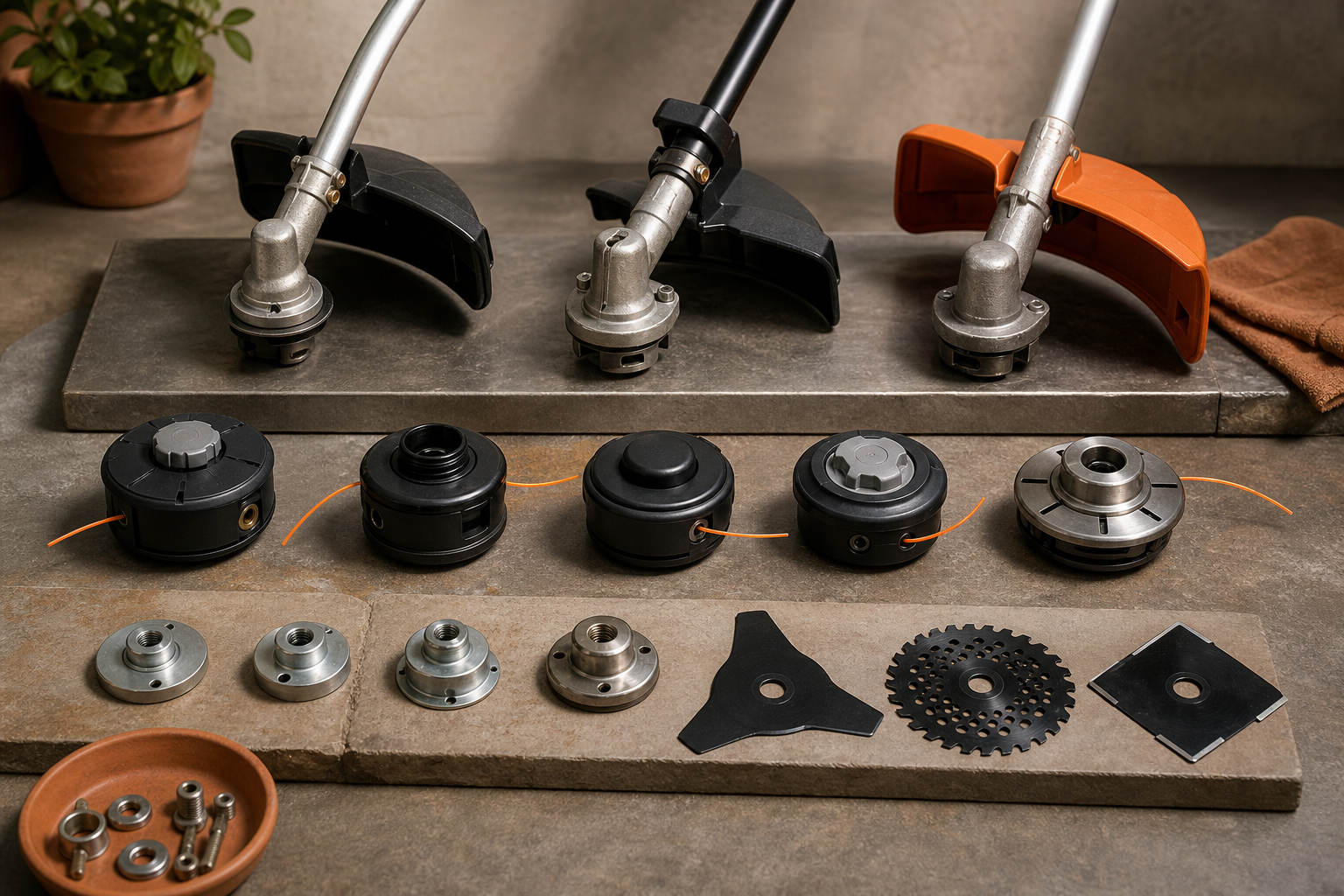
Replacing a trimmer head should be straightforward, but it’s one of the most common places buyers order the wrong part. The issue usually isn’t the head itself — it’s a missed detail like thread direction, arbor size, shaft type, or whether the unit uses a split-shaft attachment system. If you check a few key points before buying, you can avoid returns, protect the gearbox, and get a head that installs correctly and runs smoothly.
Start With the Machine Type and Shaft Style
Before comparing trimmer heads, confirm exactly what kind of machine you have. Straight-shaft and curved-shaft trimmers do not always use the same head styles, and some curved-shaft models are limited to lighter-duty heads only. A head that fits physically may still be the wrong choice for the drive system.
Check these basics first:
- Straight shaft or curved shaft
- Gas, battery, or corded electric
- Consumer/light-duty or commercial-duty
- Dedicated trimmer or multi-head power unit
Straight-shaft trimmers usually support a wider range of replacement heads, including bump-feed, fixed-line, hybrid, and heavy-duty metal-blade-compatible gearcases where approved by the manufacturer. Curved-shaft units are typically designed for lighter trimming and often use smaller heads with specific thread or arbor setups.
If you have a split-shaft or attachment-capable unit, don’t assume the lower trimmer attachment matches every powerhead the same way. Systems from Echo, Husqvarna, Ryobi, Milwaukee, Stihl Kombi, and others can differ in coupler design, drive connection, and acceptable head size. In these cases, identify both the powerhead model and the trimmer attachment model before ordering.
Check Thread Size, Thread Direction, and Mounting Hardware
This is where most ordering mistakes happen. Trimmer heads may look universal, but the mounting hardware often is not.
The main things to verify are:
- Thread size, such as M8 x 1.25, M10 x 1.25, or 3/8”-24
- Thread direction, usually left-hand or right-hand
- Female-thread head or male-stud mounting
- Whether an adapter, flange, or retaining washer is required
Many straight-shaft gas trimmers use a left-hand thread so the rotating head stays tight during operation. That means you turn it the opposite direction from standard hardware during removal and installation. Buyers often damage a shaft or strip a new head by forcing the wrong thread direction.
A few practical checks help:
- Look up the model number on the engine housing or shaft label
- Check the original parts diagram if available
- Inspect the old head or arbor for stamped thread information
- Confirm whether the replacement includes adapters
“Universal fit” heads can work well, but only if the included adapter set matches your machine exactly. If your trimmer uses a special thrust plate, rider plate, or lock washer, make sure those parts are reused or replaced as required. Missing one small mounting piece can cause wobble, poor line feed, or premature gearbox wear.
Match the Head Style to the Model Family and Intended Use
Once mounting compatibility is confirmed, choose a head that suits the machine’s design and workload. Not every trimmer is built to spin a large, heavy head.
Common replacement head types include:
- Bump-feed heads for routine grass trimming
- Fixed-line heads for simple, rugged operation
- Rapid-load or speed-feed heads for faster restringing
- Pivoting or bladed poly heads for heavy weeds, where approved
Model family matters here. A light homeowner trimmer may perform best with the original-style bump head and recommended line diameter, while a commercial straight-shaft unit may handle a larger-capacity speed-load head. Installing an oversized head on a smaller machine can reduce RPM, strain the clutch, and make starting harder.
Always check:
- Maximum line diameter the machine is rated for
- Head diameter recommended for the trimmer
- Engine or motor power
- OEM-approved replacement styles
For example, if your machine was designed for .080” or .095” line, switching to a heavy head loaded with .105” line may create feed problems and overload the unit. Battery trimmers are especially sensitive to head weight and line size because runtime and motor temperature can be affected quickly.
Verify Attachment-System Details Before You Buy
Attachment-capable machines need one more level of checking. If the trimmer head mounts to a detachable lower shaft, the fit depends on the gearbox and lower attachment, not just the powerhead brand.
Before ordering, confirm:
- The exact attachment name or part number
- Whether the lower unit uses a standard threaded arbor or proprietary mount
- The gearbox orientation and rotation direction
- Whether the manufacturer limits compatible replacement heads
Some users assume that if two brands share a similar coupler, the trimmer heads interchange the same way. That’s not always true. The coupler may fit the powerhead, but the gearbox at the cutting end may use different threads or require a specific low-profile head.
A good habit is to compare the old head to the replacement listing using:
- Model number
- Arbor/thread spec
- Shaft type
- Included hardware
- Supported brands/models in the fitment notes
If any of those details are unclear, stop before ordering. One photo of the gearbox end, old head, and model tag can save a lot of guesswork.
FAQ
How do I know if my trimmer uses left-hand threads?
Most straight-shaft trimmers use left-hand threads at the head. Check the owner’s manual, parts diagram, or markings on the gearbox/arbor. If the head loosens by turning clockwise, it is likely left-hand threaded.
Are universal trimmer heads a safe choice?
They can be, provided the thread size, thread direction, shaft style, and head weight all match your machine. “Universal” does not mean every trimmer without adjustment or adapter verification.
Can I install a heavier-duty head for thicker weeds?
Only if your trimmer is rated for it. A heavier head or thicker line can overload smaller gas, cordless, or curved-shaft units. Match the head style and line diameter to the manufacturer’s recommendations for the model family.
§ Catalog
Shop the catalog