§ How-To
Why Your Mower Deck Belt Keeps Breaking — Causes and Fixes
A worn or misrouted deck belt is the #1 cause of breakdowns. Here's how to diagnose and fix it, with a video walkthrough.
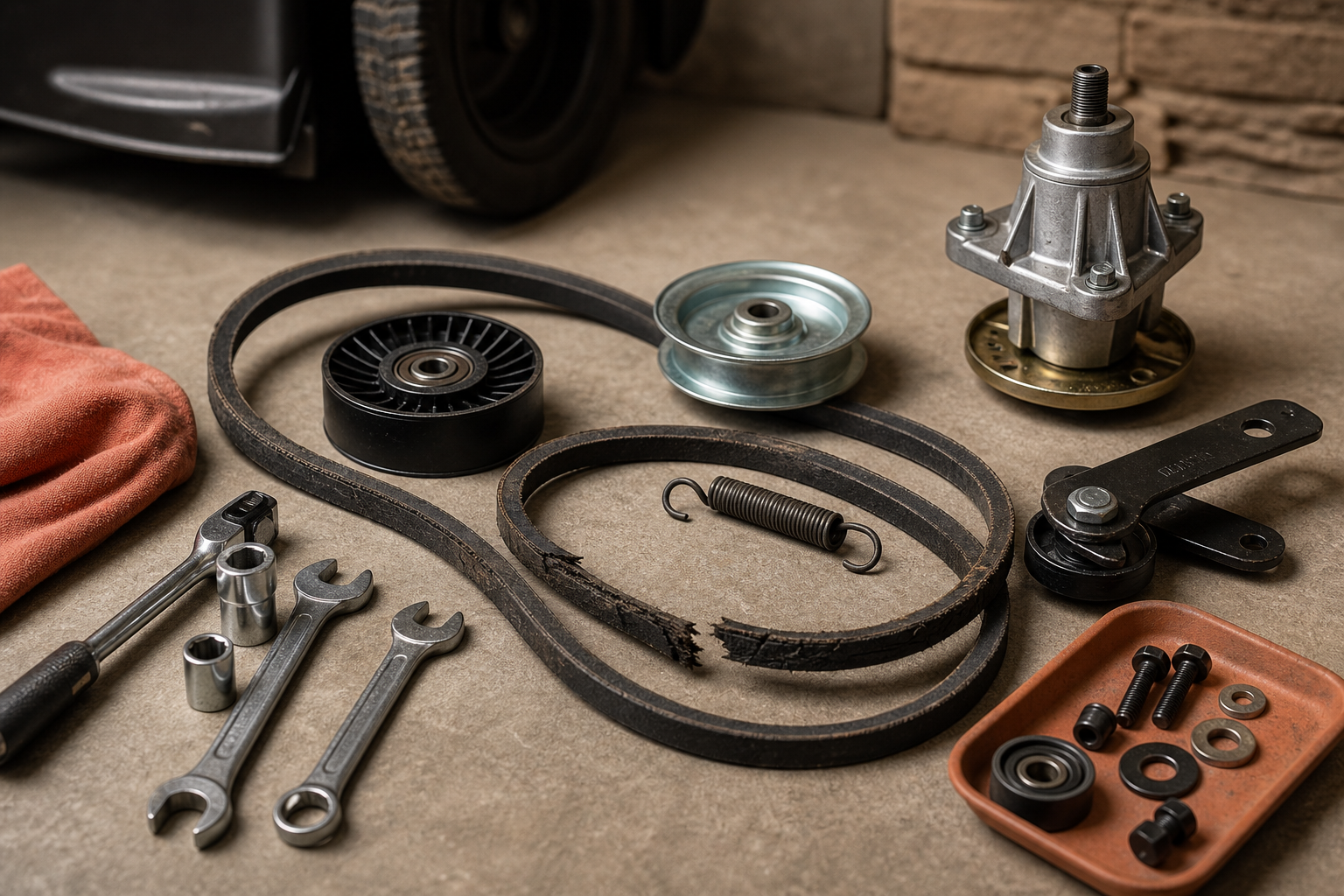
If your mower deck belt keeps breaking, coming off, or fraying at the edges, you are not alone. This is one of the most common riding mower problems owners run into, and this question comes up often in online communities and owner forums. A deck belt usually does not fail “for no reason.” In most cases, the belt is telling you something else in the deck system is worn, misaligned, seized, or installed incorrectly.
The good news is that repeated belt failure is usually fixable once you identify the real cause. Simply installing another belt may get you mowing again for a short time, but if the underlying issue remains, the new belt will often fail the same way.
What causes a mower deck belt to keep breaking?
A mower deck belt lives a hard life. It runs at high speed, bends around multiple pulleys, and transfers engine power to the blades. Because of that, even a small problem can destroy a belt quickly.
Here are the most common root causes:
1. Worn or damaged pulleys
If a pulley has a rough groove, sharp edge, wobble, or bent flange, it can cut into the belt or force it to ride at the wrong angle. Idler pulleys are especially common failure points because their bearings wear out over time.
A pulley bearing that feels gritty or loose may still spin, but not smoothly enough to protect the belt. That extra friction creates heat, and heat is one of the fastest ways to shorten belt life.
2. Seized spindle bearings
Deck spindles hold the blade shafts. When a spindle bearing starts to fail, the blade may still turn, but it takes far more effort to drive it. That overload puts constant stress on the deck belt. In severe cases, the spindle partially seizes, causing the belt to slip, burn, glaze, and eventually snap.
If your mower has a burning rubber smell, squealing from the deck, or one blade that is harder to turn by hand than the others, a spindle problem moves to the top of the suspect list.
3. Incorrect belt size or wrong belt type
This is a big one. Not every belt with the same length works on a mower deck. Deck belts are designed to handle clutching, twisting, and backside idler contact in ways many generic belts are not.
A belt that is slightly too long may jump off. A belt that is too short can overload bearings and tensioners. A standard hardware-store V-belt may fit physically but fail quickly because it is not built for deck-drive use. Using the correct OEM-spec replacement matters.
4. Misrouted belt installation
After a belt change, it is easy to route the belt incorrectly around keepers, guides, or idlers. A belt may appear to be working at first but run against a belt keeper or pulley flange until it frays and breaks.
This is why a routing diagram is so important. Many repeated belt failures happen right after replacement because the new belt is not following the exact factory path.
5. Weak tensioner spring or stuck idler arm
The tensioner system keeps the belt tight as the deck engages and runs. If the spring is stretched, broken, or disconnected, the belt can flutter, slip, and come off. If the idler arm is rusted and does not pivot freely, tension will be inconsistent.
Too little tension allows belt whipping. Too much tension can overload the belt and spindle bearings. Either condition can lead to premature failure.
6. Bent belt keepers or deck damage
Belt keepers are small metal rods or guides near pulleys that prevent the belt from jumping off during engagement. If one gets bent too close, it can rub the belt continuously. If it is bent too far away, the belt may come off under load.
A deck that has struck a stump, rock, or curb can also have slightly shifted brackets or pulley mounts. Even a small alignment issue can make a belt track poorly.
7. Debris buildup and operating conditions
Packed grass, twine, wire, and sticks under the deck can interfere with pulley movement and belt tracking. Wet mowing, heavy overgrowth, and sudden blade impacts increase load dramatically. Belts can survive hard work, but constant overload accelerates wear.
How to diagnose why the deck belt keeps failing
Before installing another belt, inspect the full deck drive system. A careful diagnosis saves money and frustration.
Start with the old belt
The failed belt can tell you a lot:
- Frayed edges usually point to misalignment, bent keepers, or pulley damage
- Glazed or shiny belt surfaces suggest slipping from low tension or seized components
- Cracks across the belt often indicate age, heat, or poor belt quality
- A clean snap can happen from sudden overload or a seized pulley/spindle
- Chunks missing may indicate debris impact or pulley interference
Check every pulley by hand
With the engine off, key removed, and spark plug wire disconnected where appropriate, rotate each pulley by hand.
Look for:
- Smooth rotation
- No grinding noise
- No side-to-side wobble
- No rough spots
- No bent pulley flanges
If an idler pulley feels loose or noisy, replace it. If a spindle pulley wobbles, inspect the spindle shaft and bearings closely.
Inspect the spindle assemblies
Grab each blade carefully, using gloves, and check for play. A blade should not rock excessively up and down. Spin each blade by hand. Resistance, rumbling, or scraping are warning signs.
Bad spindle bearings are one of the most overlooked reasons belts keep breaking.
Examine the tensioner system
Move the idler arm through its travel. It should pivot freely and return firmly under spring tension. If it sticks, the pivot may need cleaning or the arm may need replacement. Inspect the spring for stretching, rust, or improper attachment.
Verify routing and keeper clearance
Compare the belt path to the mower’s routing decal or service manual. Make sure the belt is seated fully in V-pulleys and properly riding on any flat idlers where required.
Check belt keepers near engine and deck pulleys. They should be close enough to catch a loose belt but not rubbing during normal operation.
Confirm you have the correct belt
Measure and verify the part number. If the old belt was replaced with a universal version, that may be the entire problem. This site carries compatible replacement deck belts, idler pulleys, spindle assemblies, tension springs, and related parts to match many popular riding mower models.
The fix: how to stop the belt from breaking again
Once you identify the cause, the real repair is usually straightforward.
Replace worn components as a set when needed
If the belt failed because of a bad idler pulley or spindle bearing, do not replace only the belt and hope for the best. Install the damaged component along with a fresh belt. A new belt on a failing pulley is money wasted.
Common successful repairs include:
- New deck belt and idler pulley
- New deck belt and spindle assembly
- New tension spring and idler arm
- Straightening or replacing bent belt keepers
- Correcting belt routing with the proper OEM-spec belt
Use the right deck belt
Always match the mower model and deck size. Deck belts are application-specific. Width, length, sidewall angle, and construction all matter. A quality compatible replacement from a reliable parts source is far more dependable than guessing from a shelf of generic belts.
Clean and realign the deck
Remove packed grass and debris from around the spindle housings and pulley area. If a bracket is bent, straighten or replace it. Make sure pulleys line up in the same plane. If they do not, the belt will try to climb or twist.
Check blade and spindle condition after impacts
If the mower struck something hard, inspect for bent blade shafts, cracked housings, and pulley misalignment. Belt failures that begin suddenly after an impact usually trace back to one of those issues.
Watch: Video walkthrough
If you want to see a deck belt replacement process in action, this walkthrough is a helpful reference:
Even if your exact model differs, the video gives a good look at belt routing, deck access, and the general replacement process.
Prevention tips to extend deck belt life
A deck belt is a wear item, but it should not be a frequent one. A few habits will help it last much longer:
- Inspect the belt every season for cracks, glazing, and edge wear
- Keep the deck clean so debris does not interfere with pulleys and tensioners
- Avoid mowing hidden debris like branches, wire, and rocks
- Engage blades at lower throttle when recommended by the manufacturer, then bring speed up smoothly
- Replace noisy idlers early before they damage the belt
- Check spindle bearings at the first sign of rumble or resistance
- Use the correct replacement belt, not just one that seems close
- Inspect keepers and guides after any belt comes off, since they often get bent during derailment
The main idea is simple: belts usually fail because they are being forced to do extra work or run out of alignment. Remove the cause, and the belt life improves dramatically.
FAQ
Why does my mower deck belt keep coming off instead of breaking?
A belt that comes off usually points to incorrect routing, weak tension, a bent keeper, pulley misalignment, or the wrong belt size. If left unresolved, that same issue often leads to fraying and eventual breakage.
Can I use a regular V-belt on my mower deck?
Usually no. Mower deck belts are designed for high-speed outdoor power equipment use and often must ride on backside idlers. A generic V-belt may fit, but it often wears quickly or tracks poorly.
Should I replace pulleys when I replace a broken deck belt?
Not always, but you should inspect them every time. If a pulley is noisy, rough, loose, cracked, or wobbling, replace it along with the belt. Otherwise, the new belt may fail for the same reason as the old one.
Find the right part on Amazon
Check price, stock and fitment — ships direct from Amazon.
§ Catalog
Shop the catalog